



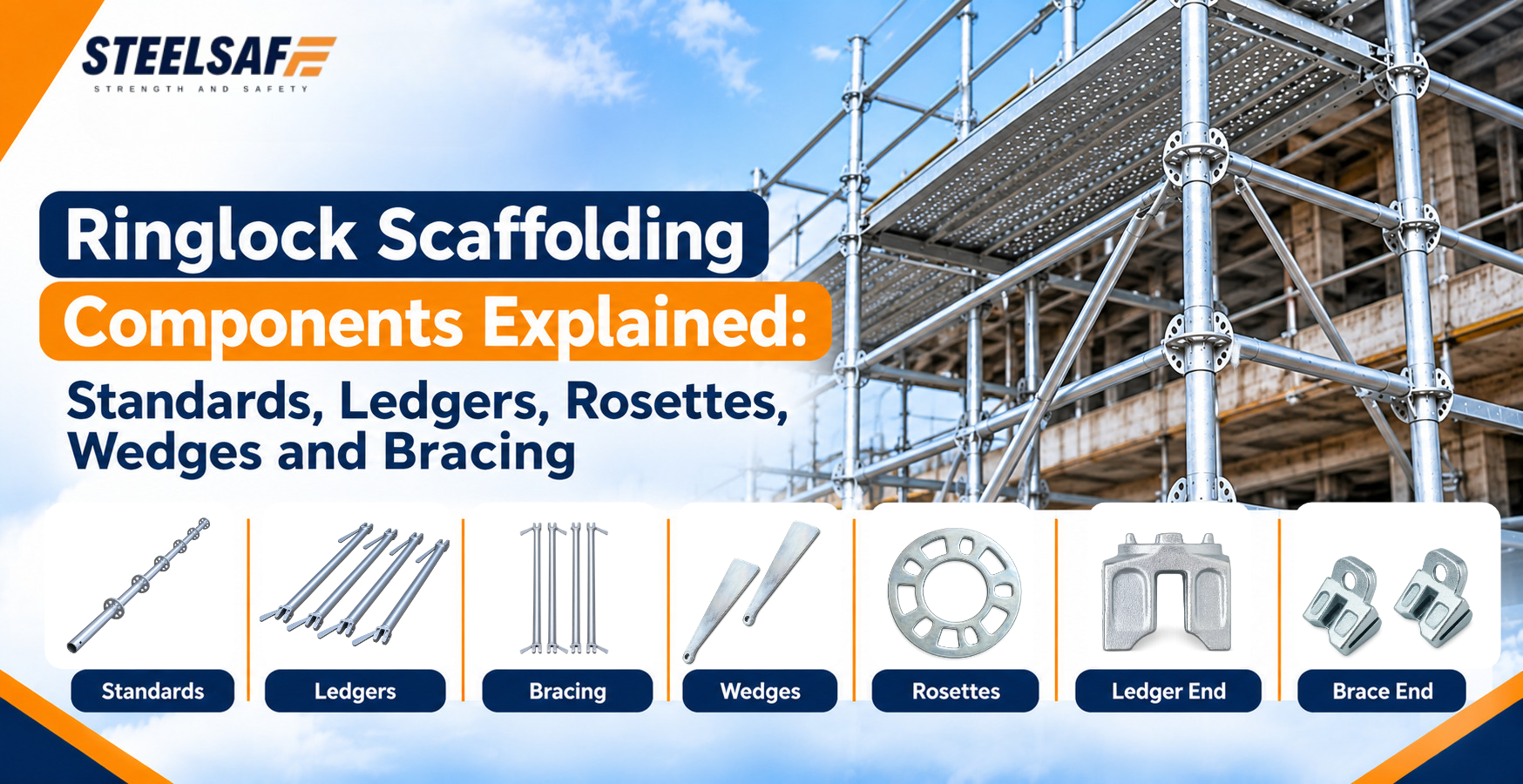
A Ringlock scaffolding system is made up of interconnected steel components that create a structured framework for construction, infrastructure and industrial work. Each component has a specific function: vertical standards provide the upright support, ledgers connect the standards horizontally, diagonal braces improve stability and rosettes with wedges form the connection points.
For contractors, infrastructure companies and procurement teams, understanding these components is important when purchasing Ringlock scaffolding. Selecting compatible parts helps simplify assembly, material planning and replacement requirements.
This guide explains the main Ringlock scaffolding components, how they connect and what to check before placing a bulk order.
1. What Is a Ringlock Scaffolding System?
A Ringlock scaffolding system is a modular steel scaffolding arrangement in which horizontal and diagonal members connect to vertical standards through rosette connection points.
Unlike conventional tube-and-coupler arrangements that rely on separate couplers for many connections, Ringlock uses a standardised connection mechanism. This allows multiple members to connect at different positions around a vertical standard.
A typical Ringlock scaffolding assembly includes:
Vertical standards
Horizontal ledgers
Diagonal bracing
Rosette connection plates
Locking wedges
Ledger ends
Brace ends
The complete arrangement depends on the project layout, required working levels, access requirements and scaffold design.
2. How Does the Ringlock Rosette Connection Work?
The rosette is the central connection point of a Ringlock scaffolding system. It is welded onto the vertical standard and provides openings where horizontal ledgers and diagonal braces can be connected.
During assembly, the end fitting of a ledger or brace is positioned against the rosette. A locking wedge is then used to secure the fitting in place.
This connection arrangement allows different members to meet at a common point. Depending on the rosette design, connections can be made in different directions and at suitable angles.
The main parts involved are:
Rosette: The connection plate fixed to the vertical standard.
Ledger end: The fitting attached to the horizontal ledger.
Brace end: The fitting attached to the diagonal brace.
Wedge: The locking element that secures the connection.
The fit and condition of these parts are important. Damaged rosettes, worn wedges or poorly fitting end connections should not be ignored during inspection.
3. Ringlock Vertical Standards
The Ringlock standard, also called a vertical standard, is the main upright member of the system. It supports the horizontal and diagonal connections and forms the vertical framework of the scaffold.
Rosettes are positioned along the standard to provide connection points at different levels. Standards are connected vertically as required by the scaffold design.
What to check when purchasing:
Pipe outside diameter and wall thickness
Required standard length and connection arrangement
Rosette positioning and welding quality
Material quality and surface finish
Compatibility with the project's Ringlock components
SteelSafe's listed Ringlock Standard Vertical is made from ISI-marked pipe, with a 48.3 mm outside diameter, 3 mm thickness and zinc-plated/GI finish. Multiple heights are listed for different project requirements.
Product: Ringlock Standard Vertical
4. Ringlock Ledgers
A Ringlock ledger is a horizontal member that connects two vertical standards. It helps establish the scaffold's horizontal layout and connects the vertical frames at the required levels.
Ledgers are used to define the length and width of scaffold bays. They also provide support for the overall framework and help maintain the intended arrangement between standards.
When selecting Ringlock ledgers, check:
Required ledger length and bay dimensions
Pipe diameter and thickness
End-fitting compatibility
Surface finish and fabrication quality
Whether the ledger matches the standards being purchased
SteelSafe lists its Ringlock Ledger Vertical as an ISI-marked pipe component with a 48.3 mm outside diameter, 3 mm thickness and zinc-plated/GI finish.
Product: Ringlock Ledger Vertical
5. Ringlock Diagonal Bracing
Diagonal bracing is used to improve the lateral stability of a Ringlock scaffolding structure. It connects scaffold members diagonally rather than horizontally or vertically.
These braces help resist sideways movement and maintain the intended geometry of the scaffold. Their placement and quantity depend on the scaffold configuration and its approved design.
When procuring diagonal bracing, consider:
Required brace lengths and bay dimensions
Correct brace-end fittings
Compatibility with the rosette connection
Pipe condition and fabrication quality
Zinc-plated/GI surface finish
SteelSafe lists Diagonal Bracing as an ISI-marked pipe component with a 48.3 mm outside diameter, 3 mm thickness and zinc-plated/GI finish.
Product: Diagonal Bracing
6. Rosettes and Wedges: Understanding Their Roles
Although rosettes and wedges work together, they perform different functions.
Ringlock Rosette
The rosette is welded onto the vertical standard and acts as the connection hub. It provides the points where ledger and brace fittings are positioned.
Its location, condition and connection geometry are important because several scaffold members may connect around the same standard.
Product: Ringlock Rosette
Ringlock Wedge
The wedge is the locking accessory used to secure ledger and brace fittings at the rosette. It helps hold the connection in its intended position.
A wedge should fit correctly and should not be bent, damaged or substituted with an unsuitable locking part.
Product: Ringlock Wedge
7. Ledger Ends and Brace Ends
Ledger ends and brace ends are fittings attached to the ends of their respective pipe members. They allow those members to connect to the rosette on a Ringlock standard.
Ledger End: This fitting is attached to a horizontal ledger pipe. It provides the connection interface between the ledger and the rosette.
Product: Ledger End
Brace End: This fitting is attached to a diagonal bracing pipe. It allows the brace to connect to the rosette and become part of the scaffold's bracing arrangement.
Product: Brace End
When purchasing replacement fittings or complete members, check that the end fitting matches the relevant pipe and rosette arrangement. A fitting that looks similar may not necessarily provide a compatible connection.
8. Ringlock Component Compatibility and Identification
One of the important considerations when buying Ringlock scaffolding components is ensuring that all parts belong to a compatible system.
A typical connection arrangement works as follows:
The vertical standard carries the rosette connection points.
The ledger connects horizontally through its ledger-end fitting.
The diagonal brace connects through its brace-end fitting.
The wedge locks the fittings at the rosette.
Before ordering, verify the following:
COMPONENT | MAIN PURPOSE | IMPORTANT CHECK |
Standard | Vertical support | Height, diameter and rosette arrangement |
Ledger | Horizontal connection | Length and ledger-end compatibility |
Diagonal brace | Lateral stability | Length and brace-end compatibility |
Rosette | Connection hub | Positioning and connection geometry |
Wedge | Locks connections | Correct fit and condition |
Ledger end | Ledger connection fitting | Compatibility with ledger and rosette |
Brace end | Brace connection fitting | Compatibility with brace and rosette |
Avoid mixing components from different manufacturers or systems without confirming their compatibility. Dimensions, connection geometry and manufacturing tolerances can vary.
9. Procurement Checklist for Ringlock Scaffolding Components
For contractors and procurement managers, preparing a component-wise material requirement before requesting a quotation can make purchasing more organised.
Use this checklist:
Project requirements: Share the project type, site layout, required working levels and intended application.
Component list: Identify the required quantities of standards, ledgers, braces, wedges, rosettes and end fittings.
Dimensions: Confirm pipe diameter, thickness, member lengths and connection details.
Compatibility: Ensure all components are suitable for the same Ringlock system.
Material and finish: Check material details, surface treatment and fabrication quality.
Inspection: Ask about product inspection and quality documentation.
Delivery planning: Confirm quantities, dispatch schedule and delivery location.
For larger projects, sharing a drawing or project-specific material list can help suppliers understand the required component combination more accurately.
10. How to Request a Ringlock Scaffolding Quotation
A clear enquiry helps suppliers prepare a more relevant quotation. Instead of requesting only a general Ringlock scaffolding price, provide a component-wise requirement.
Include:
Project location and application
Required Ringlock component names
Dimensions and quantities
Any existing system details for replacement orders
Expected delivery schedule
Project drawings or material list, if available
SteelSafe offers Ringlock components as part of its MS Scaffolding range. Contractors and procurement teams can enquire about individual components or project-specific material requirements.
Frequently Asked Questions
1. What are the main components of a Ringlock scaffolding system?
The main components include vertical standards, horizontal ledgers, diagonal braces, rosettes, wedges, ledger ends and brace ends. Each part contributes to the connection or framework of the scaffold.
2. What is the purpose of a rosette in Ringlock scaffolding?
A rosette is welded onto the vertical standard and acts as a connection hub. It allows ledger and brace fittings to connect at different positions around the standard.
3. What does a Ringlock wedge do?
A Ringlock wedge locks the ledger-end or brace-end fitting against the rosette, helping secure the connection.
4. What is the difference between a Ringlock ledger and diagonal brace?
A ledger is a horizontal member connecting vertical standards. A diagonal brace connects scaffold members diagonally to improve lateral stability.
5. Can Ringlock components from different manufacturers be used together?
They should not be mixed without checking compatibility. Pipe dimensions, rosette geometry, end fittings and locking arrangements must match the intended system.
6. What information is required for a Ringlock scaffolding quotation?
Share the component list, required dimensions, quantities, project location, application and delivery requirements. Drawings or an existing material list can help clarify the requirement.
Conclusion
A Ringlock scaffolding system depends on the correct coordination of its individual components. Standards form the vertical framework, ledgers establish horizontal connections, diagonal braces improve lateral stability, and rosettes, wedges and end fittings complete the connection arrangement.
For contractors and procurement teams, understanding these parts makes it easier to identify requirements, check compatibility and prepare an accurate material list before ordering.
Contact SteelSafe
Website: Steelsafe.co.in
Email: info@steelsafe.co.in
Phone: +91 96670 74359
Contact SteelSafe for a Ringlock component quotation or to discuss your project-specific scaffolding material requirements.