



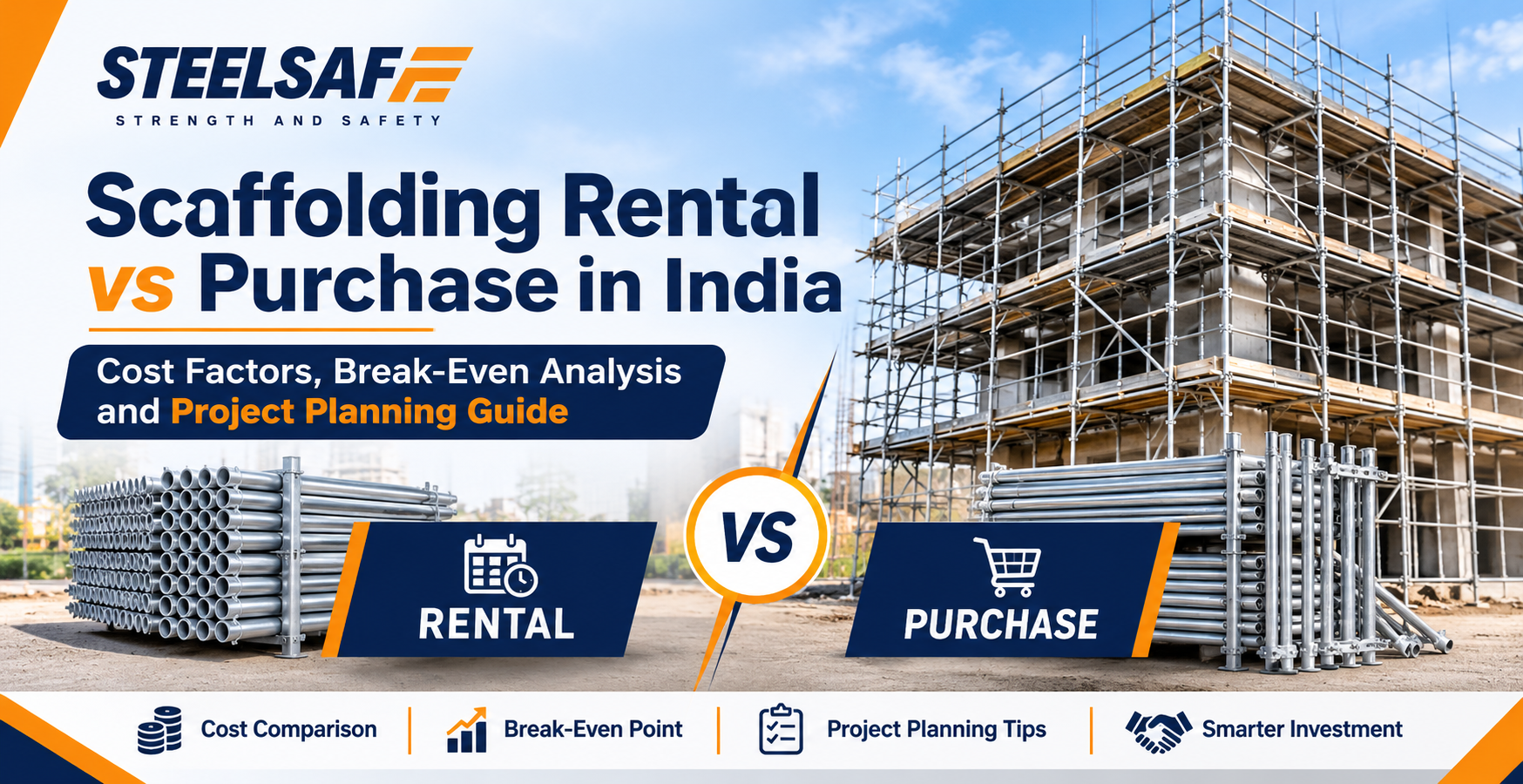
Choosing between scaffolding rental and purchase is an important decision for contractors, builders and construction project managers. While purchasing scaffolding offers long-term ownership, renting can reduce initial investment and provide flexibility for projects with specific equipment requirements.
However, the right option depends on several factors, including project duration, equipment utilisation, transportation, maintenance, storage and future requirements.
So, should you buy or rent scaffolding for your next construction project?
This guide explains how scaffolding rental works in India, compares rental and purchase costs, provides a practical break-even calculation and highlights what contractors should consider before selecting a scaffolding supplier.
1. What Is Scaffolding Rental?
Scaffolding rental is the process of hiring scaffolding equipment from a supplier for an agreed period instead of purchasing it.
It allows contractors to access the equipment required for construction, infrastructure, maintenance and industrial projects without making a substantial upfront investment.
Scaffolding on rent is particularly useful when:
Equipment is required for a specific project or construction phase.
The company has limited capital for equipment purchases.
Scaffolding requirements vary between projects.
There is limited space for equipment storage.
Purchasing equipment would result in underutilised inventory.
The rental arrangement generally specifies the equipment quantity, rental duration, applicable charges, transportation and return conditions.
2. How Does Scaffolding Rental Work in India?
The scaffolding rental process generally involves the following steps:
Step 1: Identify project requirements
Determine the project location, working height, construction activity, required scaffolding system and approximate equipment quantity.
Step 2: Select the scaffolding system
Identify the suitable system, such as Cuplock or Ringlock scaffolding, according to the project design and application.
Step 3: Request a quotation
Share the project details, required components, estimated quantity and rental duration with the supplier.
Step 4: Review rental terms
Check the rental charges, minimum rental period, security deposit, transportation expenses, maintenance responsibilities and damage policy.
Step 5: Arrange delivery and inspection
Coordinate material delivery according to the construction schedule. Verify the equipment quantity and condition upon arrival.
Step 6: Return the equipment
After completing the requirement, arrange dismantling, material reconciliation and return transportation according to the rental agreement.
Planning a construction project? Contact SteelSafe to discuss your scaffolding rental requirements and request a project-specific quotation.
3. Scaffolding Rental vs Purchase: Which Is Better?
Both options have financial and operational advantages. The right choice depends on how frequently the equipment will be used and whether the business can manage ownership responsibilities.
Comparison factor | Scaffolding rental | Scaffolding purchase |
Initial investment | Lower upfront investment | Higher capital investment |
Project duration | Suitable for temporary requirements | Suitable for repeated, long-term use |
Maintenance | Depends on rental agreement | Managed by equipment owner |
Storage | Generally not required after return | Requires storage facilities |
Flexibility | Easier to arrange changing requirements | Limited to owned inventory |
Ownership | No equipment ownership | Full equipment ownership |
Cash flow | Rental payments over time | Capital invested upfront |
Future projects | New rental arrangements required | Existing equipment can be reused |
When Should You Choose Scaffolding Rental?
Renting is generally suitable when:
The project has a defined duration.
Equipment requirements are temporary or irregular.
The company is handling a one-time construction project.
Capital needs to be allocated to other project activities.
Storage and maintenance facilities are limited.
When Should You Purchase Scaffolding?
Purchasing may be more economical when:
The company has continuous construction projects.
Equipment is used regularly throughout the year.
The same scaffolding configuration is required repeatedly.
Adequate storage and maintenance facilities are available.
Equipment can be reused across multiple project sites.
The most important factor is actual equipment utilisation rather than simply comparing the initial purchase price with monthly rental charges.
4. How Project Duration Affects Scaffolding Rental Costs
Project duration plays a major role in determining whether renting or purchasing is more economical.
Short-term projects: Renting can be a practical option for activities such as building repairs, painting, façade work and temporary construction requirements.
Medium-term projects: Contractors should compare cumulative rental expenses with the purchase price, maintenance costs and potential resale value.
Long-term projects: Purchasing may provide better value when equipment is used continuously or across multiple projects.
Another important consideration is equipment utilisation. If scaffolding is required only during certain construction phases, paying rental charges throughout periods of inactivity can increase project expenses.
Preparing an equipment utilisation schedule can help contractors make a better procurement decision.
5. Scaffolding Rental Cost: Important Factors to Consider
Scaffolding rental cost in India varies according to the equipment, project location, rental duration and supplier's commercial terms.
The following factors influence the total expense:
1. Type of scaffolding system: Cuplock, Ringlock and other scaffolding systems have different component requirements and configurations.
2. Rental duration: Daily, weekly or monthly billing arrangements can affect the cumulative rental expense. Minimum rental periods and extension charges should be confirmed.
3. Equipment quantity: The required number of standards, ledgers, braces, base jacks, walkway planks and accessories influences the quotation.
4. Transportation: Freight depends on the distance, material volume, vehicle requirements and delivery arrangements.
5. Loading and unloading: Labour and equipment required for material handling may involve additional charges.
6. Security deposit and additional expenses: Some agreements include refundable deposits, replacement charges or other commercial conditions.
Before finalising a quotation, request an itemised cost breakdown covering rental charges, transportation, applicable taxes, deposits and other expenses.
Looking for an accurate scaffolding rental estimate? Share your project location, equipment quantity and expected rental duration with SteelSafe to discuss your requirements.
6. Transportation, Maintenance and Storage Considerations
The actual cost of scaffolding extends beyond rental or purchase charges. Contractors should also consider logistics and equipment management.
Transportation and Handling
Scaffolding components are generally transported in multiple quantities, making logistics an important cost factor.
Consider:
Transportation from the supplier to the project site.
Loading and unloading expenses.
Internal movement of materials within the site.
Return transportation after project completion.
Sorting and material reconciliation.
Maintenance and Equipment Condition
Purchased scaffolding requires regular inspection, cleaning, maintenance and proper storage.
With rental, maintenance and replacement responsibilities depend on the agreement. However, contractors must still ensure that equipment is inspected before use and that damaged or unsuitable components are not installed.
Storage Requirements
Purchased equipment requires adequate storage space between projects. Improper storage can contribute to corrosion, damage and component loss.
Rental can reduce long-term inventory and storage requirements because equipment can be returned after the agreed usage period.
7. What Scaffolding Equipment Can Be Rented?
The availability of scaffolding equipment depends on the supplier's inventory and project requirements.
Commonly used MS scaffolding components include:
Cuplock Scaffolding: A modular system using cup-and-blade connections to join vertical standards and horizontal ledgers.
Ringlock Scaffolding: A modular system using rosette connections to accommodate different scaffold configurations.
Base Jacks and U Jacks: Adjustable components used in scaffolding base and support arrangements.
Walkway Planks: Platforms that provide working surfaces within compatible scaffolding structures.
Scaffolding Accessories: Clamps, couplers, braces, tie rods and other connecting components.
The selection should depend on the project design, working height, loading requirements and site conditions.
Explore SteelSafe's MS Scaffolding Systems and Scaffolding Accessories to understand the available product range. Confirm individual equipment availability for rental before finalising your requirement.
8. How to Calculate Your Scaffolding Rental Requirement
Accurate quantity estimation helps prevent material shortages, unnecessary rental expenses and project delays.
Before requesting a quotation, follow these steps:
Assess the working area: Identify building dimensions, working height and the areas requiring scaffolding.
Select the scaffolding system: Determine whether Cuplock, Ringlock or another suitable arrangement is required.
Prepare a BOQ: List the required standards, ledgers, braces, base jacks, walkway planks and accessories.
Estimate the rental period: Consider installation, actual usage and dismantling schedules.
Plan delivery and return: Coordinate dispatch and collection according to the construction programme.
Request a detailed quotation: Share the BOQ and project details with the supplier.
For larger projects, providing drawings and a component-wise BOQ can help improve quantity estimation and quotation accuracy.
9. How to Request a Project-Specific Scaffolding Rental Quotation
A project-specific quotation provides a more accurate estimate than a general rental price because every construction site has different equipment and logistical requirements.
Share the following details with your supplier:
Required information | Details |
Project location | City, state and site address |
Project duration | Expected number of days or months |
Required system | Cuplock, Ringlock or other specified system |
Approximate quantity | Component-wise BOQ or estimated requirement |
Delivery date | Expected material delivery schedule |
Project drawings | Layouts, elevations or scaffolding drawings, if available |
Providing complete information helps the supplier understand your requirements, check equipment availability and prepare a relevant quotation.
Frequently Asked Questions About Scaffolding Rental
1. Is scaffolding rental cheaper than purchasing?
Scaffolding rental can be more economical for short-term projects because it reduces initial investment and storage responsibilities. Purchasing may provide better value when equipment is used regularly across multiple projects.
2. What factors affect scaffolding rental cost in India?
The cost depends on the scaffolding system, quantity, rental duration, project location, transportation, handling and applicable commercial terms.
3. Can I get MS scaffolding on rent?
MS scaffolding rental availability depends on the supplier's inventory and project requirements. Share your required system, quantity, location and rental duration to confirm availability.
4. What is the minimum rental period for scaffolding?
The minimum rental period varies by supplier. Rental agreements may follow daily, weekly or monthly billing arrangements.
5. Who is responsible for damaged scaffolding during rental?
Responsibility depends on the rental agreement. Inspection, damage reporting, maintenance and replacement conditions should be clearly established before delivery.
6. Can scaffolding be rented for long-term projects?
Yes, long-term rental arrangements may be possible depending on equipment availability and mutually agreed commercial terms. Compare cumulative rental expenses with the cost of ownership before deciding.
7. What information is required for a scaffolding rental quotation?
Suppliers generally require the project location, scaffolding system, estimated quantity, rental duration and expected delivery date. Drawings and a BOQ can help improve quotation accuracy.
8. How can I request scaffolding rental from SteelSafe?
You can contact SteelSafe through its official contact page. Share your project details and equipment requirements to discuss rental availability and pricing.
Conclusion
The decision between scaffolding rental and purchase should depend on project duration, equipment utilisation, transportation, maintenance and long-term business requirements.
Rental can help contractors manage temporary equipment needs without making a substantial initial investment, while purchasing may offer better value when scaffolding is used continuously across multiple projects.
Evaluating the complete cost of both options helps construction companies make informed procurement decisions while managing project budgets and operational requirements.
Contact SteelSafe
Website: https://steelsafe.co.in/
Email: info@steelsafe.co.in
Phone: +91 96670 74359
Request your scaffolding rental quotation today and get the right scaffolding solutions for your project requirements.